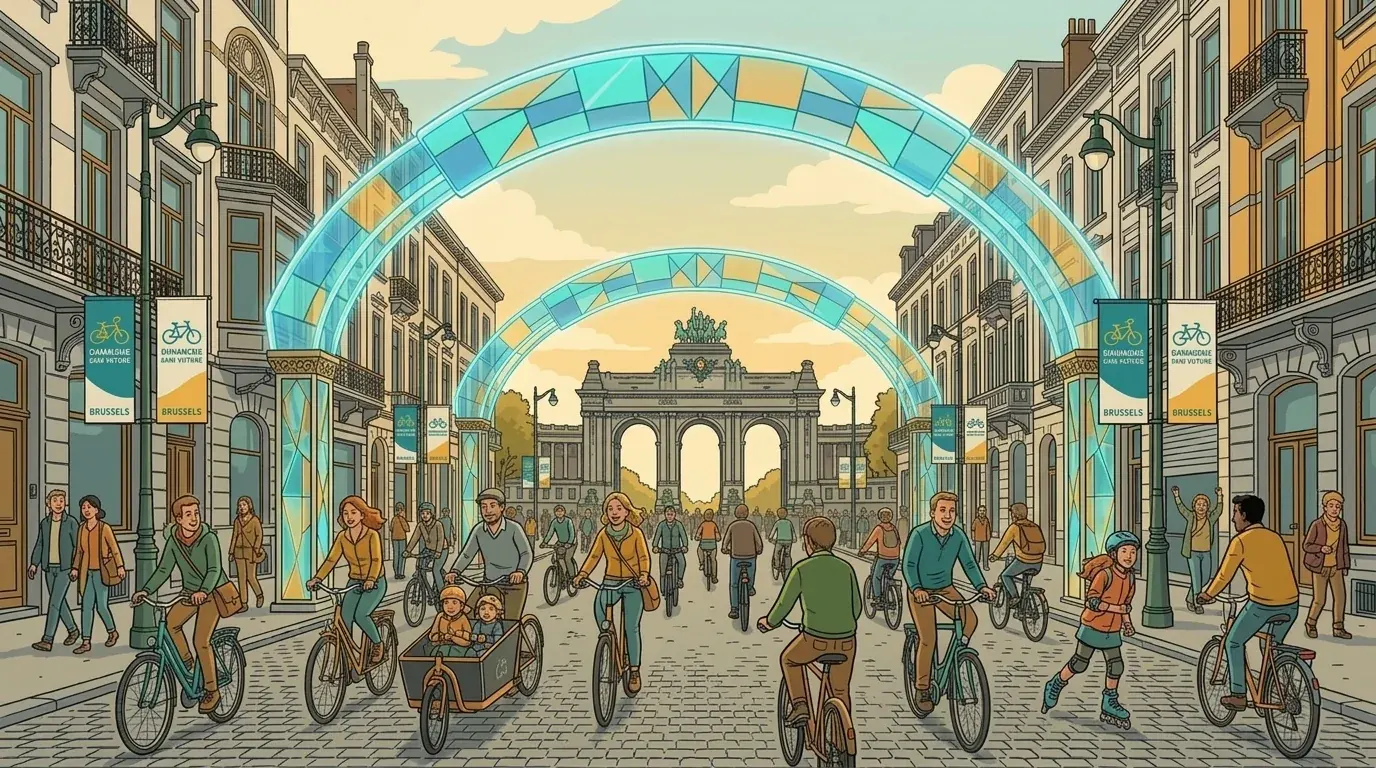
Dimanche sans voiture in Brussels: From Schaerbeek to White Star, Union Scarves, a Pistolet Américain, and Frites Évidemment
Dispatched at 23:42 on Sunday night after 19 communes (and 20+ Walloon towns) traded car horns for bicycle bells, 50 years of Brussels Metro nostalgia, a proper pistolet américain, and a cone of double-fried frites.
Sunday, September 20, 2026 · 23:42 CEST · Schaerbeek, Brussels.
It is 11:42 PM. The city outside the window has quietly returned to its usual Sunday-night murmur, the last folding tables from the neighborhood brocantes have been stacked away, and my legs have that unmistakable, pleasant heaviness that only comes from spending an entire September day treating 162 square kilometers of Brussels asphalt like a giant village square.
Every year at 09:30 sharp on Car-Free Sunday (Dimanche sans voiture / Autoloze Zondag), someone turns the volume knob of the capital down by twenty decibels—and turns the civic warmth up by fifty.
You don’t even have to be anti-car to love it; in fact, some of the biggest smiles you see in the middle of the Reyers and Cinquantenaire tunnels belong to everyday commuters who spend the other 364 days of the year staring at brake lights in those exact same underground tubes. For one glorious Sunday between 09:30 and 19:00, nobody is stuck behind a bumper. Everybody is just outside.
What Made the 2026 Edition Special Across Brussels & Wallonia
As highlighted in Sudinfo’s mobility roundup (Journée sans voiture : les activités mobilité à ne pas manquer !), this year’s edition—anchoring European Mobility Week (September 16–22, 2026)—brought together the best of Belgian street life:
- All 19 Brussels Communes Wide Open: Free STIB public transport across the region, pop-up bike repair workshops (ateliers de réparation vélo), guided cycling and heritage walks, street parties (fêtes de quartier and brocantes from Schaerbeek to Rue de Liverpool in Anderlecht), and a special nod to 50 years of the Brussels Metro (les 50 ans du métro bruxellois).
- A Historic First South of the Language Border: For the very first time in 2026, Wallonia joined the movement at a regional scale, with more than twenty Walloon municipalities—including Spa, Ath, Hannut, Wavre, and Bertrix—closing their town centers to motorized traffic so families, pedestrians, and cyclists could reclaim their main squares.
- Doubling Down for 2027 (Spring + Autumn!): Because one Sunday a year has clearly become too short for Brussels’ appetite, the capital is officially turning Dimanche sans voiture into a biannual tradition:
- Spring Edition (New Addition!): Debuting on Sunday, May 2, 2027, and in future years permanently aligning with the Iris Festival weekend in early May (official announcement reel).
- Autumn Edition (Traditional): Continuing its classic mid-September placement during European Mobility Week (already penciled in for Sunday, September 19, 2027).
Twice a year—once when the May chestnut blossoms open, and once in the golden September light. Hard to argue with that kind of urban upgrade.
Our Sunday Loop: Schaerbeek, White Star & Union Colors
Every Brusseleir household has its own unwritten Sunday compass, and ours always starts on the wide avenues of Schaerbeek.
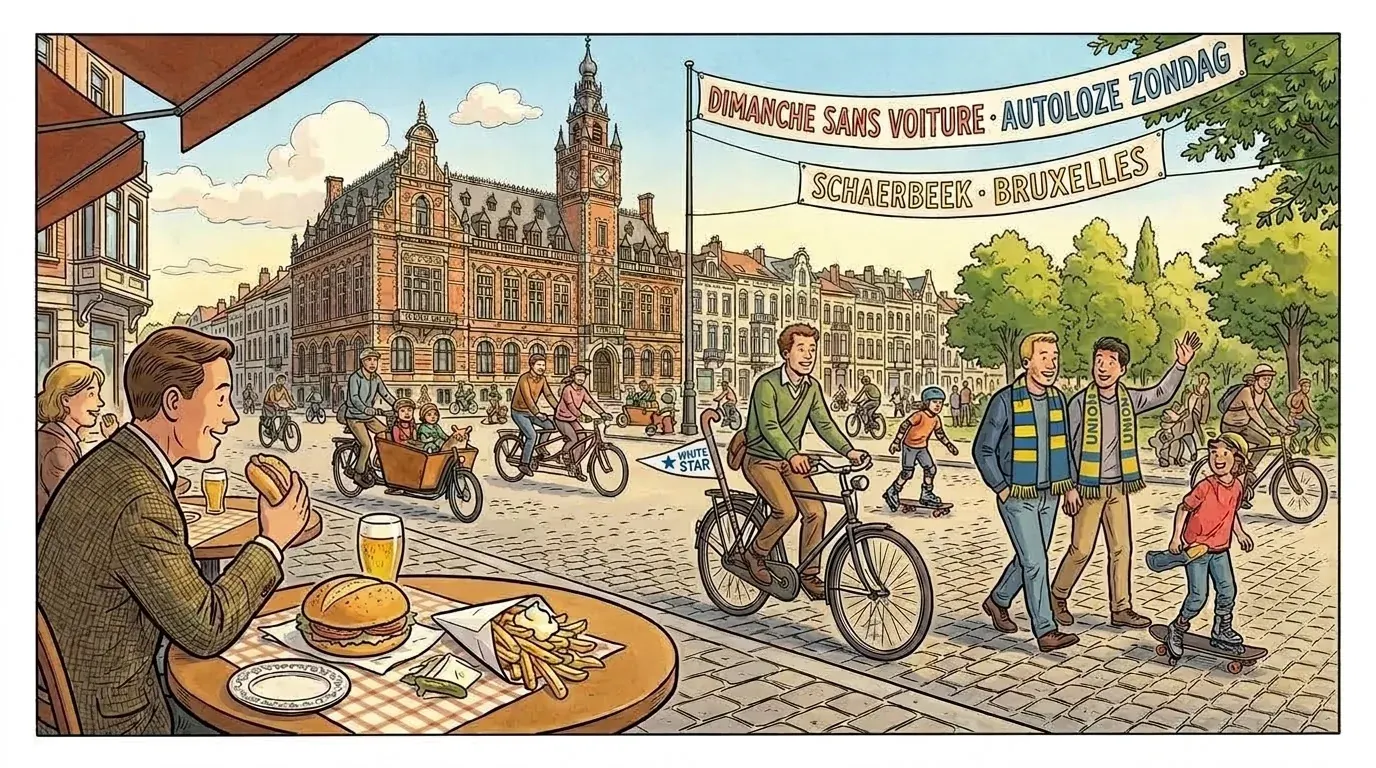
Rolling past the Flemish Neo-Renaissance gables of the Hôtel Communal on Place Colignon and skirting the green slopes of Parc Josaphat, you get the full, affectionate panorama of Brussels on two wheels:
- The Hockey Convoy: Kids, teens, and parents pedaling toward Royal White Star HC (l’Étoile Blanche) with field hockey sticks strapped across backpacks or poking out of wooden cargo bikes like jousting lances. There is something deeply civilized about rolling up to the pitch for a Sunday match without having hunted for a single parking spot.
- The Yellow-and-Blue Scarf Brigade: Drift across town toward Saint-Gilles and Forest and you immediately run into the cheerful yellow-and-royal-blue tide of Royale Union Saint-Gilloise (RUSG). Between matchday songs, terrace debates, and kids kicking a foam ball down the middle of the chaussée, Union brings its own unmistakable neighborhood soul to the day.
- The Tunnel Peloton: Balance bikes, tandems, rollerblades, cargo bikes with sleepy dogs wearing goggles, and grandparents cruising side by side down boulevards that normally demand eyes in the back of your helmet.
The Two Non-Negotiable Checkpoints: Pistolet Américain & Des Frites, Évidemment
Let’s be honest: all those kilometers logged across Brussels hills are really just an elaborate, guilt-free justification for the two culinary monuments of a proper Belgian Sunday.
1. Mid-Morning: Un Pistolet Américain
Before noon, follow the line outside any real neighborhood boulangerie in Schaerbeek. You are there for a pistolet—that round, golden, airy Belgian roll with its signature cleft down the middle and a crust engineered to shatter into crisp flakes the instant you bite into it.
Order it the classic way: un pistolet américain. Generously spread with freshly seasoned filet américain préparé (Worcester sauce, capers, finely chopped shallots, zero shortcuts), crunchy cornichons, and a handful of peppery cressonnette (watercress). Eaten on a sunlit bench while watching an entire brass band pedal past on cargo bikes, it beats any white-tablecloth brunch on earth.
2. Late Afternoon: Des Frites, Évidemment
And by early evening, on the ride back home toward 1030 Schaerbeek with tired legs and happy faces, there is only one lawful way to close the loop: a stop at the neighborhood fritkot.
Double-fried in beef tallow (blanc de bœuf)—first at 135 °C to turn the inside of the Bintje potato into a cloud, then rested, then plunged at 175 °C for that golden crunch—served hot in a paper cone (un cornet) with salt from above and a generous swirl of mayonnaise or andalouse. Des frites, évidemment.
See you on the boulevards again on May 2, 2027!
References & Further Reading
- Sudinfo Mobility Highlights (Sept 20, 2026): Journée sans voiture : les activités mobilité à ne pas manquer !
- Visit Brussels Official Event Guide: Car-Free Sunday (Dimanche sans voiture / Autoloze Zondag)
- Biannual Calendar Expansion (May 2, 2027 + Sept 19, 2027): Official Announcement Reel
- Friday Night Run Companion Post: Google AI Café Brussels Connected Cup: Four Weeks of Espresso and Agents After the 10,30 km de Schaerbeek Night Run