Carnets d'Atelier in Ligne Claire: Brewing Agents, Spanner Graphs, and a Brussels Trilogue
An espresso doppio, five autonomous agents negotiating a Qualified Majority, and a week of zero-trust engineering between Schuman and Place de Londres.
In the European Quarter of Brussels, consensus is traditionally measured in corrigenda, late-night trilogues, and the structural resilience of an espresso doppio.
This week, the late-September sun over the capital was generous enough to turn every bike ride—back and forth between home, the schools, the office, and our Connected Cup pop-up near Schuman—into an open-air architecture review. When a week of distributed systems engineering finally converges in a room full of thirty builders under a spinning disco ball, there is only one proper Belgian medium to document it: en ligne claire.
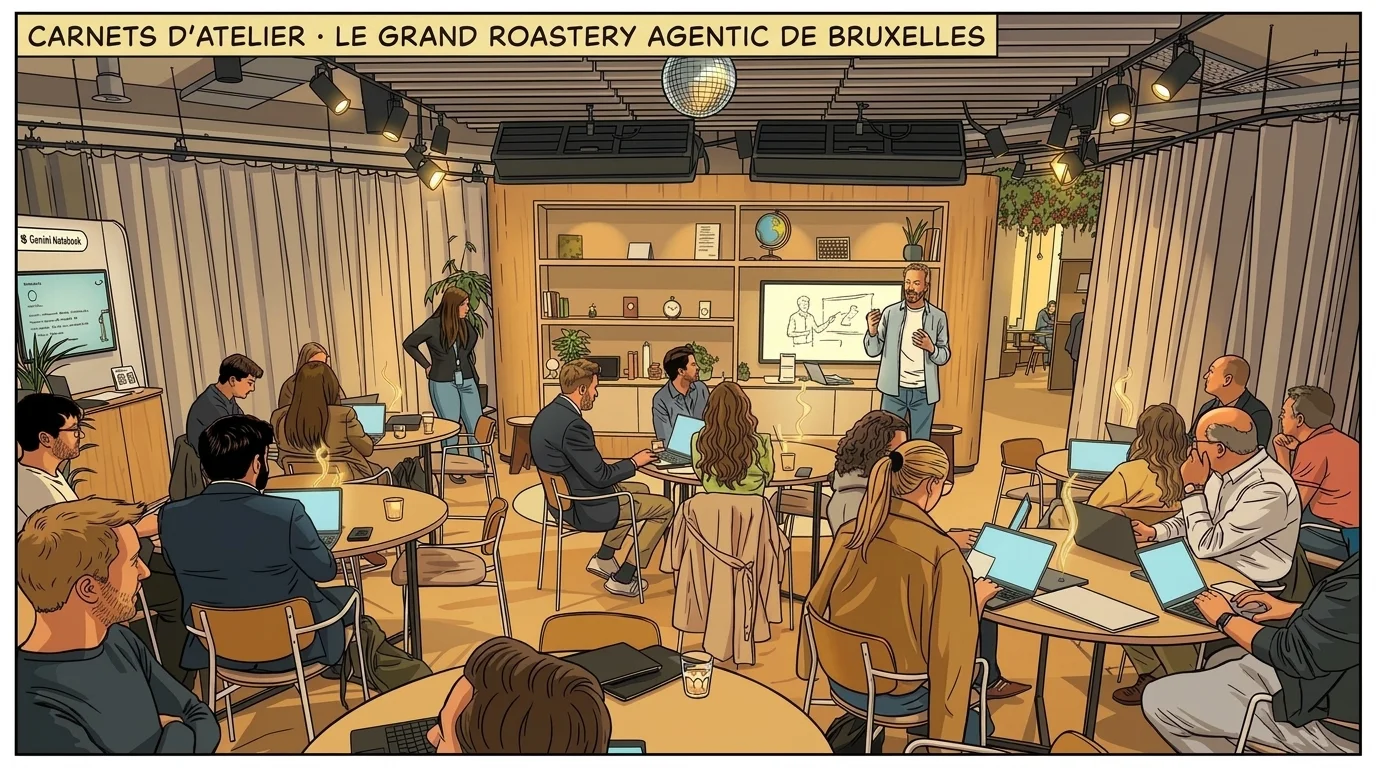
Le Grand Roastery Agentic de Bruxelles: Friday’s hands-on ADK & Agent Platform session at the Connected Cup, inked in classic Hergé & Jacobs ligne claire.
If Professor Mortimer had spent the week pairing with coding agents in europe-west1, he would have been inspecting Agent2Agent (A2A) JSON-RPC handshakes while Tintin interrogated a local Brain Visualizer daemon on port :8088. Pull up a chair, order a doppio, and let’s inspect the three systems I have been brewing in the workshop this week.
1. The Brewed Artifacts: Inside the Connected Cup Arena
For Friday’s Introduction to Agents with ADK session, a static slide deck would have been an insult to a room that reads legislative impact assessments before breakfast. When you seat thirty engineers, architects, and policy-fluent builders around five oak tables—christened Squad Espresso (831), Squad Cortado (832), Squad Flat White (833), Squad Pour-Over (834), and Squad Cold Brew (835)—you need a live, self-paced control plane.
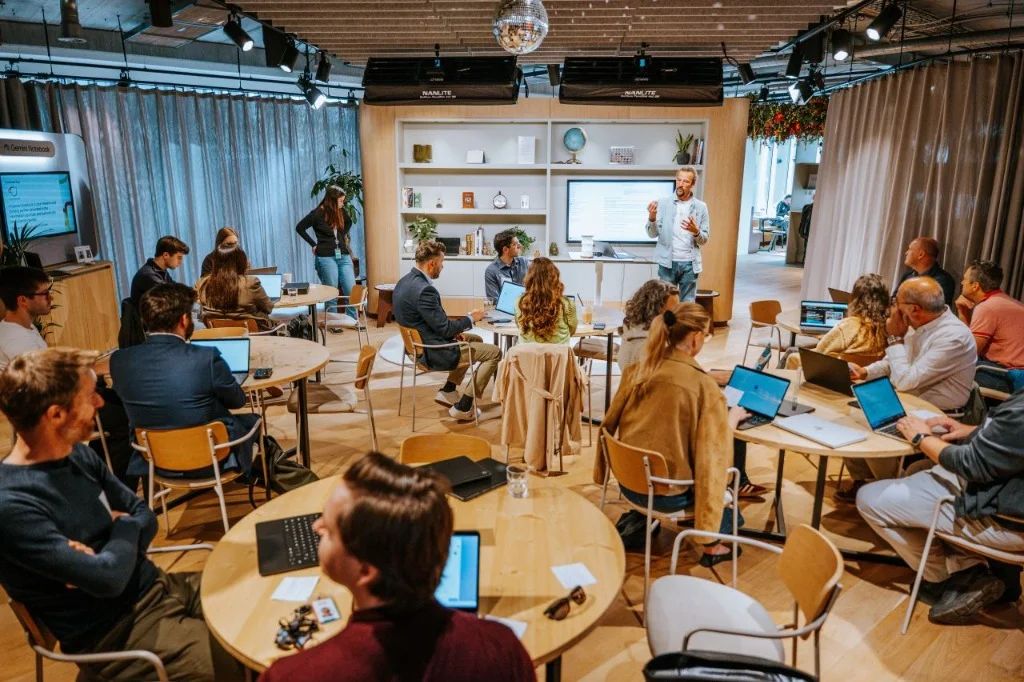
So we shipped the dedicated Friday pop-up portal at 25sep.aicafe.netdev.be, deployed on serverless Cloud Run in Belgium (europe-west1) and structured around three engineering movements:
I. Three-Minute Zero-Friction Onboarding
Nothing derails a hands-on session faster than IAM permission loops or consumer quota ceilings—the cloud equivalent of getting stuck in a comitology procedural vote. The onboarding track binds each pre-provisioned squad project directly to Gemini Enterprise Agent Platform quotas, launches Cloud Shell Editor with the Google Antigravity CLI (agy) pre-wired, and verifies SDK credentials in under 180 seconds.
II. Twenty-Six Challenges & The COREPER II Trilogue Simulator
Rather than a toy “hello-world” chatbot, we designed two core tracks, seven specialty pours, and thirty progressive challenges culminating in a quintessentially Brussels boss fight: The 5-Node A2A Eurocrat Trilogue Capstone.
Anyone who has ever watched a directive move between the Commission, the Parliament, and the Council knows that “multi-agent orchestration with conflicting system prompts” was actually invented on Rue de la Loi in 1958. Our capstone wires five autonomous Agent Development Kit (ADK) agents over the Agent2Agent (A2A) protocol into a live COREPER II Qualified Majority Voting (QMV) Simulator—enforcing the exact Treaty of Lisbon double-majority threshold in code:
- Member State Quorum: At least $55%$ of Member States ($\ge 15$ out of $27$), and
- Demographic Weight: Representing at least $65%$ of the total EU population (with a blocking minority requiring at least four Council members representing $>35%$ of the population).
Watching five autonomous LLM agents negotiate amendments until their JSON payload clears $65%$ demographic weight is remarkably therapeutic—and takes roughly four hours less than the real thing.
III. The 9-Bar Socratic “AI Barista Coach”
Tucked into the bottom-right corner of the portal is my favorite mechanism of the week: a resizable AI Barista Coach calibrated to 🛡️ 9-Bar pressure (the exact hydrostatic pressure required to pull a proper espresso doppio).
If an assistant immediately dumps the final Python code when a builder hits a snag, zero learning occurs. Instead, the coach enforces a three-stage progressive extraction valve:
1 · Nudge(Shot 1/3): A Socratic architectural hint pointing to the relevant protocol invariant or schema contract.2 · Steps(Shot 2/3): The structural workflow and CLI diagnostic sequence.3 · Code(Shot 3/3 —+1 Shotescalation): Copy-ready ADK,agy, orRemoteA2aAgentimplementation snippets when you genuinely need a double shot to unblock your pipeline.
The 8-Hour Live Telemetry Scorecard (08:40 – 16:55 CEST)
How did the control plane behave when all five tables hit peak velocity between 11:00 and 14:00 CEST?
| Telemetry Dimension | 8-Hour Live Measurement | Engineering Highlight |
|---|---|---|
| Platform Availability | 100% (0 HTTP 5xx) |
Across all 8 Cloud Run microservices in europe-west1 (2,545 non-probe HTTP requests). |
| Metered GCP API Calls | 10,733 calls |
Including 1,745 Vertex AI invocations and 498 Agent Registry discoveries. |
| Cloud Audit Log Events | 2,265 audit events |
2,180 human-initiated builder actions (79.9% concentrated in the three-hour midday sprint). |
| Socratic AI Barista Chats | 50 live coaching turns |
100% HTTP 200 OK with a 4.2s median streaming response time. |
| Artifacts Shipped by Builders | 10 AI Agents + 1 Cloud Run App |
5 Gemini Enterprise no-code agents, 4 Vertex AI Reasoning Engines, 1 ADK Python agent, and 1 live regulatory intelligence Cloud Run web app. |
| Arena Leaderboard Podium | 🏆 #1 Squad Cortado (832) |
Squad Cortado took gold with 1,500 pts (1,000/1,000 from the multimodal AI Judge), edging out Squad Espresso (831, 1,480 pts) by a razor-thin 20 points. |
2. Les Carnets de l’Atelier: The Three Technical Brews of the Week
While Friday’s arena was the public stage, the back-office workshop was humming all week across three deeper architectural tracks—distilled here into a three-panel ligne claire technical plate:
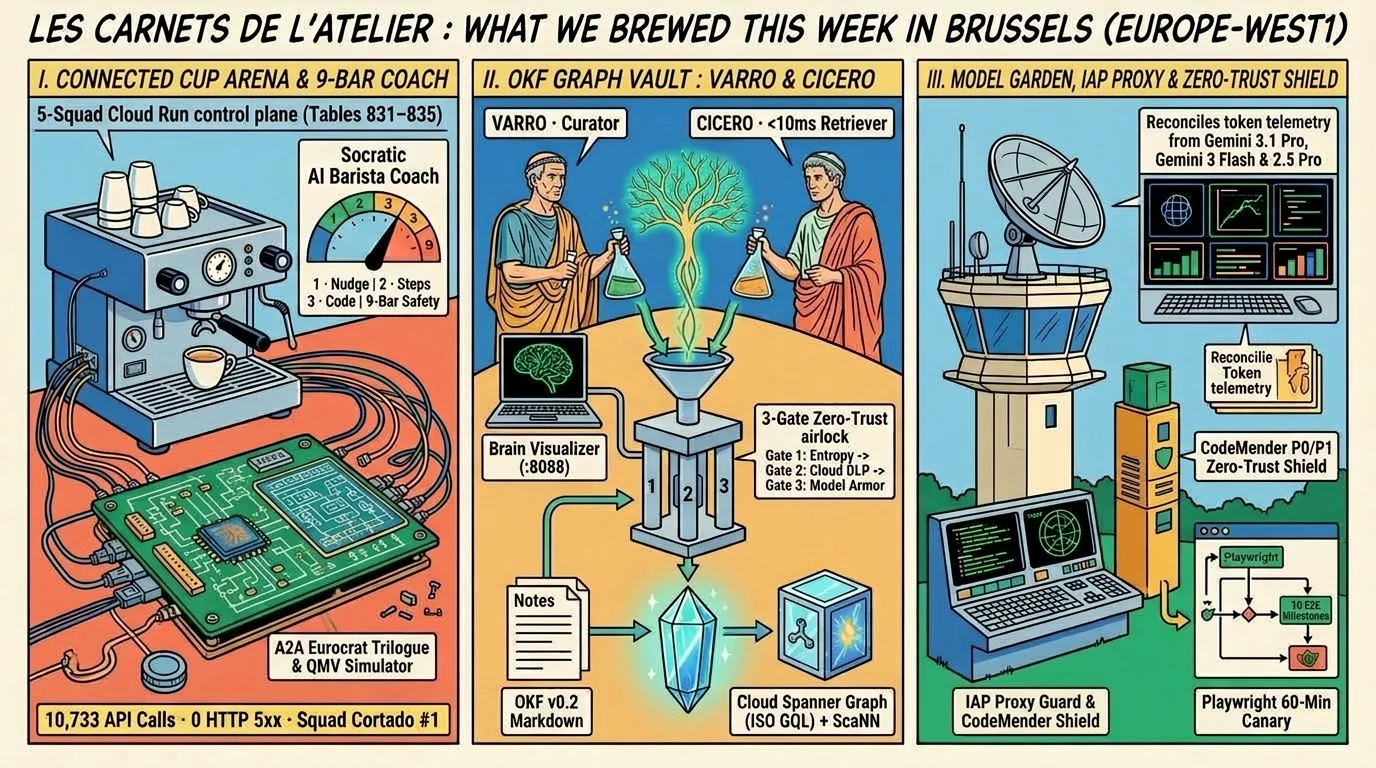 Les Carnets de l’Atelier: (I) The 5-Squad Cloud Run Control Plane & 9-Bar Socratic Coach, (II) The OKF Graph Vault with Varro & Cicero on Cloud Spanner Graph, and (III) Model Garden Token Reconciliation, IAP Proxy Guard & CodeMender Zero-Trust Shield.
Panel I · The 5-Squad Control Plane & A2A Trilogue Engine
Wiring the espresso machine directly into our serverless control plane let every squad move seamlessly from zero-friction onboarding to BigQuery MCP data agents and A2A Qualified Majority simulations—backed by real-time Cloud Monitoring telemetry and Socratic coaching.
Panel II · From OKF Theory to Running Code: Varro, Cicero, and the Spanner Graph Vault
Earlier this week, I wrote about why the Open Knowledge Format (OKF) and WikiSkill are essential to bridge individual agent introspection with institutional memory. Over the past few days, I turned that specification into a two-tier compounding knowledge vault written in Pure Go, Cloud Spanner Graph (ISO GQL), and ScaNN vector search.
Traditional enterprise knowledge management tries to scrape noisy human chat channels and email threads—producing a compliance migraine and low-signal chatter. Our OKF Graph Vault inverts the paradigm:
- Hybrid Brain Visualizer Ingestion (
:8088): A local bridge tails high-signal agent execution trajectories (transcript_full.jsonlviainotifybyte-offset checkpoints) alongside REST calls to Guillaume Laforge’s local Antigravity Brain Visualizer Micronaut daemon ([::1]:18088). - Two Roman Agent Personas (Varro & Cicero):
- Varro (The Curator): Named after Marcus Terentius Varro, Rome’s greatest librarian. Varro runs asynchronously to distill raw debugging trajectories into human-readable OKF v0.2 Markdown notes with strict
#tech/*,#practice/*, and#workload/*taxonomies and mandatory> **Sources**:provenance links. - Cicero (The Retriever): Named after the master orator. Instead of dumping bloated vector chunks into a context window, Cicero executes a three-turn progressive disclosure retrieval (
<10msindex catalog lookup $\rightarrow$<50mstargeted section extraction $\rightarrow$ dual-scope synthesis across the developer’s local vault and the shared Cloud Spanner Graph).
- Varro (The Curator): Named after Marcus Terentius Varro, Rome’s greatest librarian. Varro runs asynchronously to distill raw debugging trajectories into human-readable OKF v0.2 Markdown notes with strict
- The 3-Gate Zero-Trust Sanitization Airlock: Nothing ever auto-syncs from a developer’s workstation. When an engineer explicitly stages an insight for the shared organizational brain, it must pass through three deterministic and AI guardrails before touching storage:
- Gate 1 (Workstation): Local regex + Shannon entropy redaction of keys, tokens, IPs, and sensitive identifiers.
- Gate 2 (Cloud Edge): Cloud Data Loss Prevention (Cloud DLP) de-identification templates.
- Gate 3 (Cognitive Shield): Vertex AI Model Armor prompt-injection and sensitive-data screening before the OKF v0.2 node and its
DEPENDS_ON/SUPERSEDESedges are committed via ISO GQL to Cloud Spanner Graph.
Panel III · Model Garden Token Telemetry, IAP Proxy Guard & 60-Min Canaries
Finally, on the right panel of our workshop notebook, we tightened the bolts across observability and perimeter security:
- 12-Model Vertex AI Token Reconciliation: We aligned our observability control plane strictly with all 12 verified Vertex AI Model Garden Gemini models (Gemini 3.1 Pro, Gemini 3 Flash, and the Gemini 2.5 Pro / Flash / Flash-Lite family), reconciling exact input, output, and reasoning token burn directly against OpenTelemetry trace spans.
IAP Proxy Guard& Zero-TrustCodeMenderShield: We ran both initial and adversarial CodeMender sweeps across our local zero-trust Identity-Aware Proxy guard (IAP Proxy Guard) and authentication middleware—eliminating every P0 and P1 finding before Friday’s live traffic hit.- Bilingual
OKFMaps & 60-Min Playwright Canary: We shipped a full French/English (FR/EN) OKF Knowledge Base switcher and consolidated fragmented browser checks into a single, deterministic 60-minute Playwright E2E canary lifecycle verifying 10 deep-analysis milestones.
Epilogue: From Schuman to Place de Londres
When the final telemetry sweep wrapped up late Friday afternoon with 0 HTTP 5xx errors and Squad Cortado crowned on the podium, it was time to close the laptop, unlock the bike, and coast through the late-afternoon sunshine over to Place de Londres in Ixelles. Raising a glass on the terrace of London Calling while the square hummed in five languages—before pedaling home at dusk to light the charcoal for a quiet Friday night barbecue with the teens—was the best possible reminder of why we build in Brussels.
The Connected Cup continues in the EU Quarter through October 16, 2026, and the Builder Hub stays open whenever you want to test your agents against the 26 challenges. Next time you’re near Schuman, drop by—the espresso doppio is on us.